Dream to Assist: Intent-Conditioned World Models for Shared Vehicle Control
1Toyota Research Institute, Cambridge, MA · 2Toyota Research Institute, Los Altos, CA · 3Massachusetts Institute of Technology
Contact: Jonathan DeCastro, jonathan.decastro@tri.global
Looking for the conference paper? Dreaming to Assist (CoRL 2024) has its own page. This page covers the extended version, which adds human-subjects studies and an on-vehicle deployment.
Abstract
Assistive agents in shared-control settings face a dual challenge: acting proactively to align with the human's intentions while remaining legible enough for the human to comprehend and fluently respond in real time. We present Dream2Assist, a model-based reinforcement learning framework for tightly-coupled shared decision making that addresses both sides of this challenge. Our approach extends a recurrent state-space world model with intent inference, enabling an assistive policy trained via fictitious co-play with the human to anticipate and support discrete human objectives without overriding human agency.
Beyond the computational framework, we describe the full deployment pipeline needed to translate a world-model-based policy into a safe, human-centered system in a resource-efficient way. Crucially, we address the sim-to-real-human gap via policy down-selection and reward restructuring within an iterative human-machine interface design. We validate the framework through three human-subjects studies and a preliminary on-vehicle deployment spanning two qualitatively distinct domains: high-speed racing (N = 30) and urban driving with richer intent structure (N = 10). Our results demonstrate that intent conditioning yields measurable improvements in torque alignment and collision rate. We surface key design insights and practices for deploying learning-based assistive agents in safety-critical, real-time human-robot teaming.
Method: a world model that knows what you are trying to do
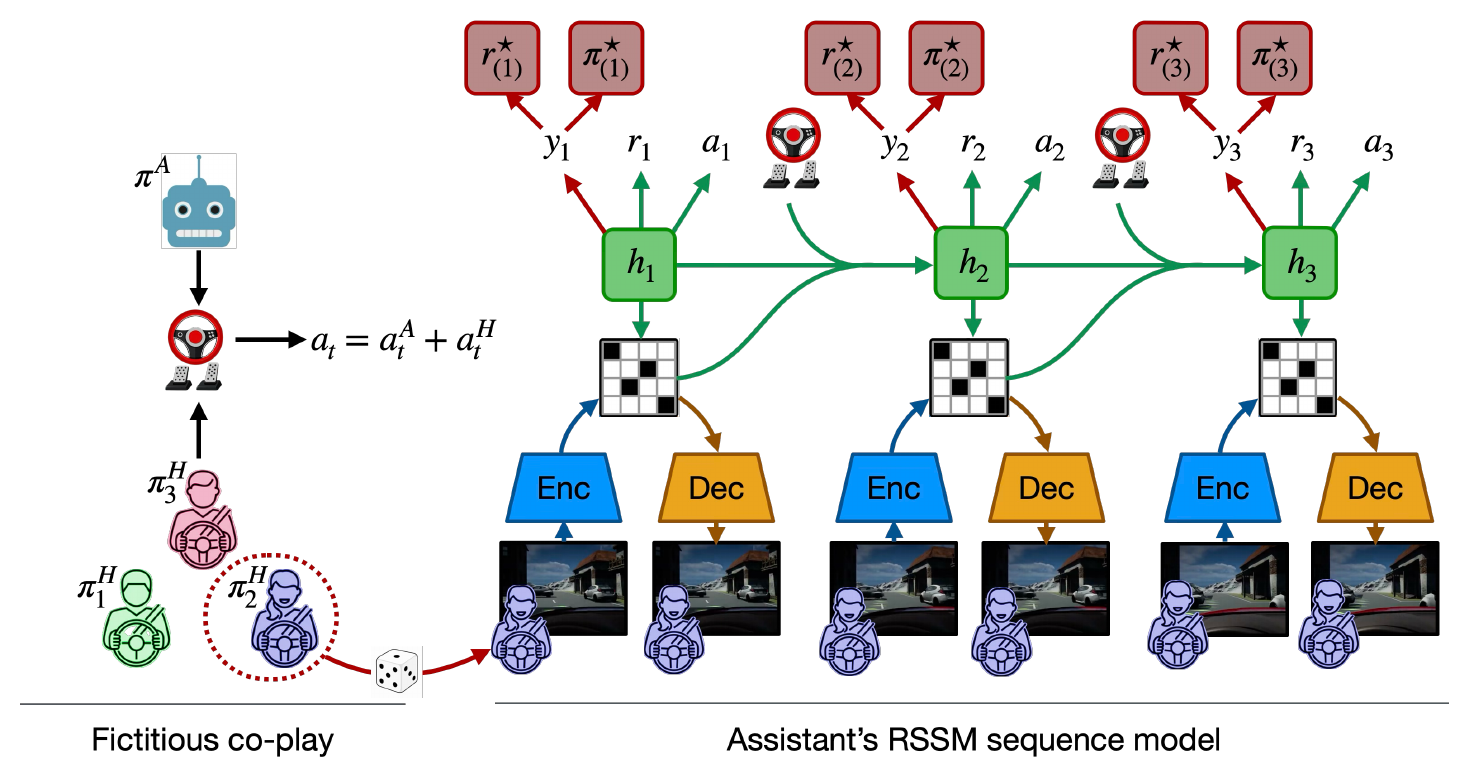
Dream2Assist gives an assistant a latent model of its human partner. The assistant reads the driver's behavior, infers a discrete objective such as pass versus stay behind, or left versus right around a hazard, and shapes its assistance to fit.
Three ingredients
- Intent-aware world model. A DreamerV3-style RSSM with an added intent predictor on the assistant's latent state. The inferred intent is re-estimated at every step from a window of latent states, so it can follow changes during an episode.
- Fictitious co-play. The assistant trains alongside a population of simulated drivers with different objectives and different skill levels, taken from checkpoints along their own training. The assistant learns to cope with imperfect partners, and learns to tell the intents apart.
- Value-aligned reward. The assistant is rewarded for the task, penalized for the size of its own intervention, and rewarded for acting like an expert that shares the inferred intent.
Here ŷA is the inferred intent, r̂* the reward an intent-aligned expert would receive, and a* the action that expert would take. All evaluations in the paper use the reward-only variant (αr = 1, αa = 0).
Defaults to light assistance, by construction
Assistance stays light in two situations. If the driver is already driving the way an intent-aligned expert would, there is little to correct, and the intervention penalty keeps the assistant's input small. If the system is uncertain which intent the driver holds, the intent-conditioned reward terms approximately cancel, leaving the task reward and the intervention penalty, so the assistant again intervenes less. In between, assistance ramps up as the driver's behavior departs from what the expert for the inferred intent would do, and ramps down as the system becomes more uncertain of the driver's intent. No special case is coded for any of this. It follows from the shape of the reward.
Safety layer
A control-barrier-function filter sits on top of the learned policy and activates only near a constraint boundary. In the human studies reported here it was applied to the trajectory visualization shown to the driver, not to the assistive torque, in order to isolate the effect of intent conditioning on the torque itself.
From simulation to a system people can use
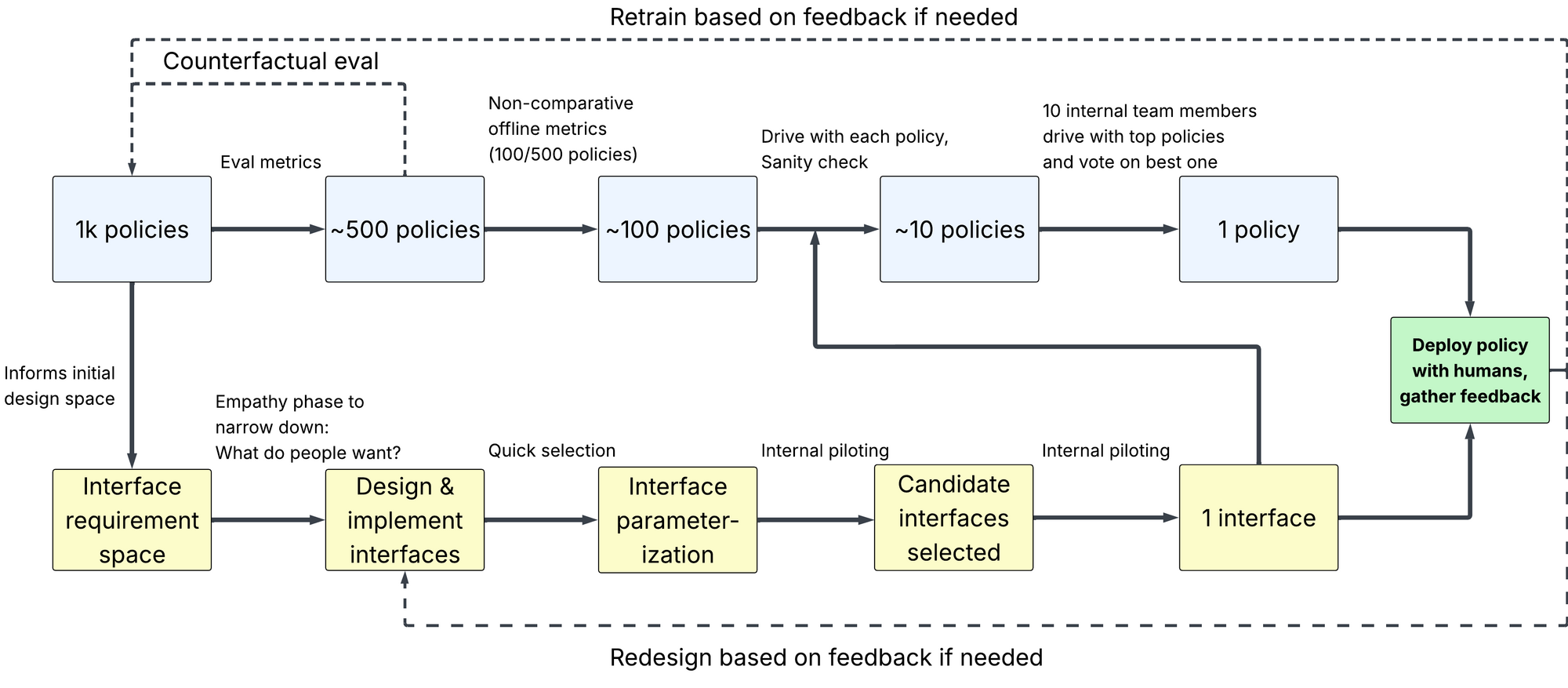
A policy that works with simulated partners is not yet a system that works with people. The paper contributes a deployment pipeline that combines automated policy screening, counterfactual log replay, and human-in-the-loop vetting with an interface-design process that is resolved before policy quality is formally evaluated.
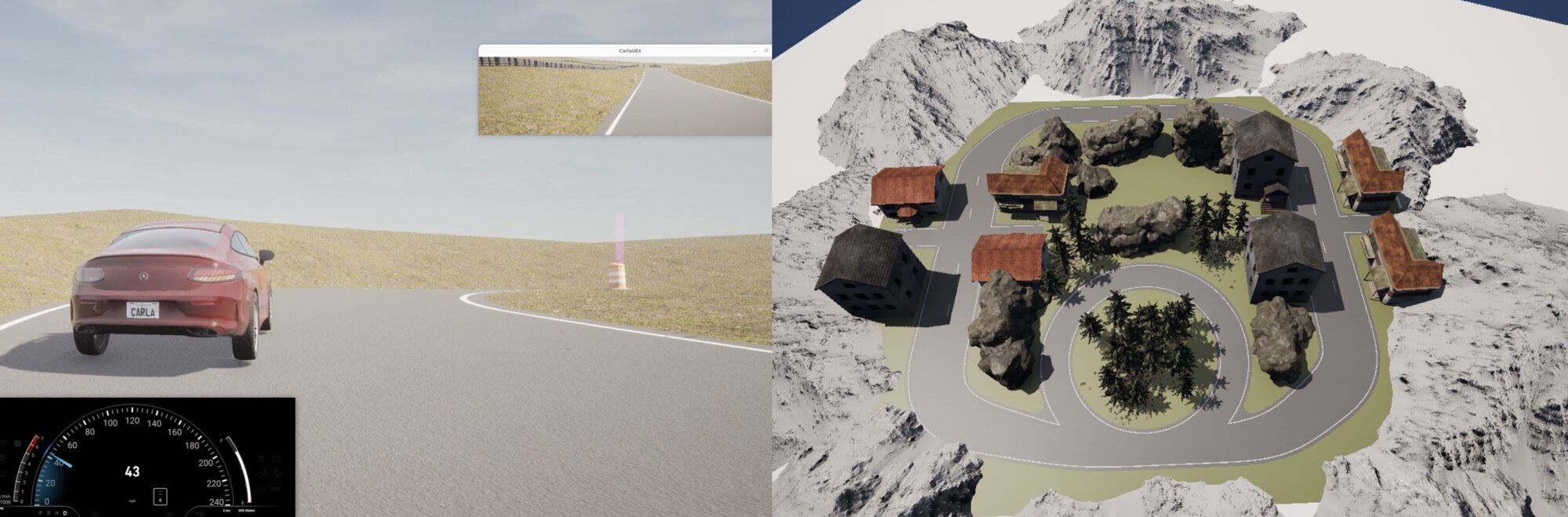
Two domains, three studies, one on-vehicle deployment
| Study | N | Comparison | Purpose |
|---|---|---|---|
| Eval 1 Racing characterization | 24 | Assisted vs unassisted | Characterize shared control across track geometries and identify where to refine |
| Eval 2 Racing refinement | 6 | Refined vs initial policy, within subjects | Check that targeted refinements improved the Eval 1 turn behavior |
| Eval 3 Urban validation | 10 | Intent vs no intent, double-blind A/B | Isolate the contribution of intent conditioning |
| GRIP Test vehicle (VR) | 3 | Intent vs no intent | Feasibility of transfer with no retraining |
Drivers see the assistant's planned path as a green dashed line ahead of the car and feel its steering input as torque on the wheel. Steering is coupled: the road wheels follow the steering wheel, and the assistant communicates by applying torque the driver can follow or override at any time. Throttle and brake are uncoupled, so the driver does not feel longitudinal assistance through the pedals.
Racing: strong on straights, and a clear path on turns
Eval 1: characterization (N = 24)
Drivers attempted eight overtakes of increasing difficulty, each with and without assistance. On straights, assistance raised overtake success from 80% to 88% (p = .069) and increased both overtake speed and minimum clearance to the opponent. Turns were harder: overtake success was lower with assistance (about 55% without, about 27% with), as was clearance. Inspecting the assistive inputs pointed to over-steering just before the turn, which gave us a specific target for refinement.
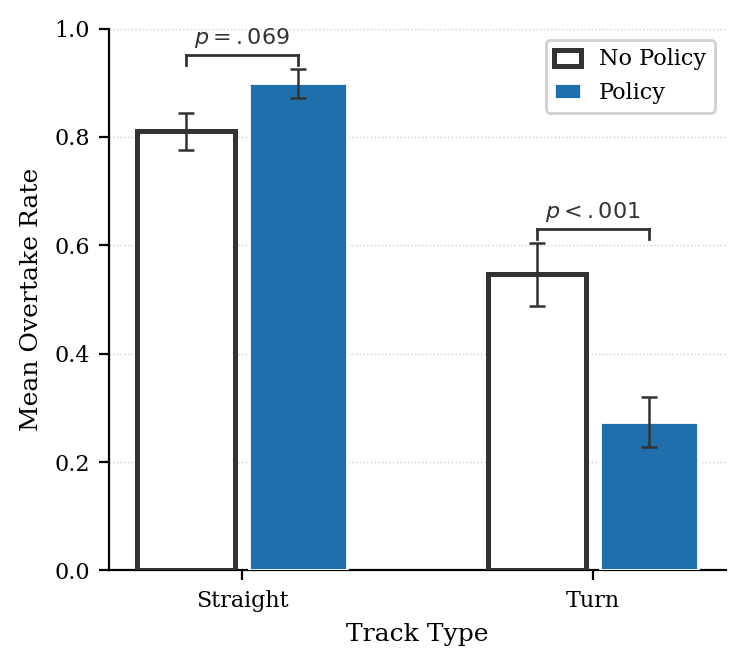
Participants rated the assistant as understanding their intent to pass well above neutral (about 5.3 on a 7-point scale, p < .001), and safety was rated above neutral overall and clearly so on straights. Helpfulness and safety ratings followed the same straight-versus-turn split as the objective results.
What the turn results taught us
The simulated partners steered more aggressively, and more repeatably, in turns than real people do. The world model learned overly aggressive turn dynamics from them, which produced steering over-compensation. That diagnosis directly shaped the refinements in Eval 2.
Eval 2: targeted refinement (N = 6)
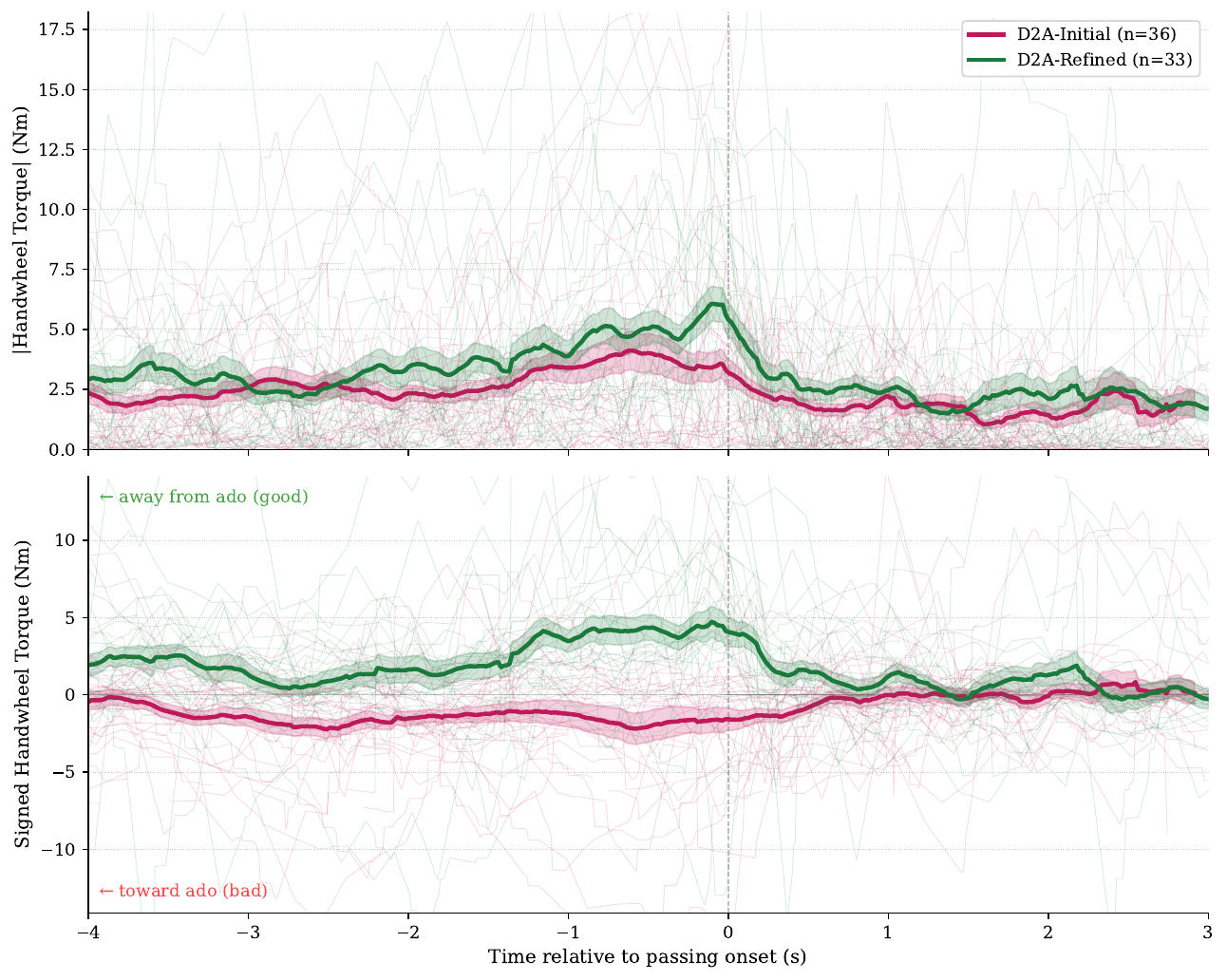
The refinements were human-data augmentation, output smoothing, and reward restructuring that penalizes collapse to a single intent. The refinements moved the policy in the intended direction: net intent-aligned steering torque improved by about 1.1 Nm (paired t-test, p = .049), the refined policy was preferred on 16 of 27 trials and on a majority of turn trials, and likability rose (3.31 vs 2.95). The pilot is small and aimed at direction rather than significance, so the likability and preference differences are not statistically significant.
Urban: isolating the effect of intent
Eval 3 is the cleanest test. Same architecture, same rewards, same safety layer, and the intent predictor is the only difference. Participants did not know which assistant they were driving.
The hazards, driven without assistance
Two of the surprise events in the town scenario, shown with a person driving without the assistant. These are human-driven runs from our CompactSim setup.
Same scenario, two assistants
Steers with the driver, and collisions more than halved
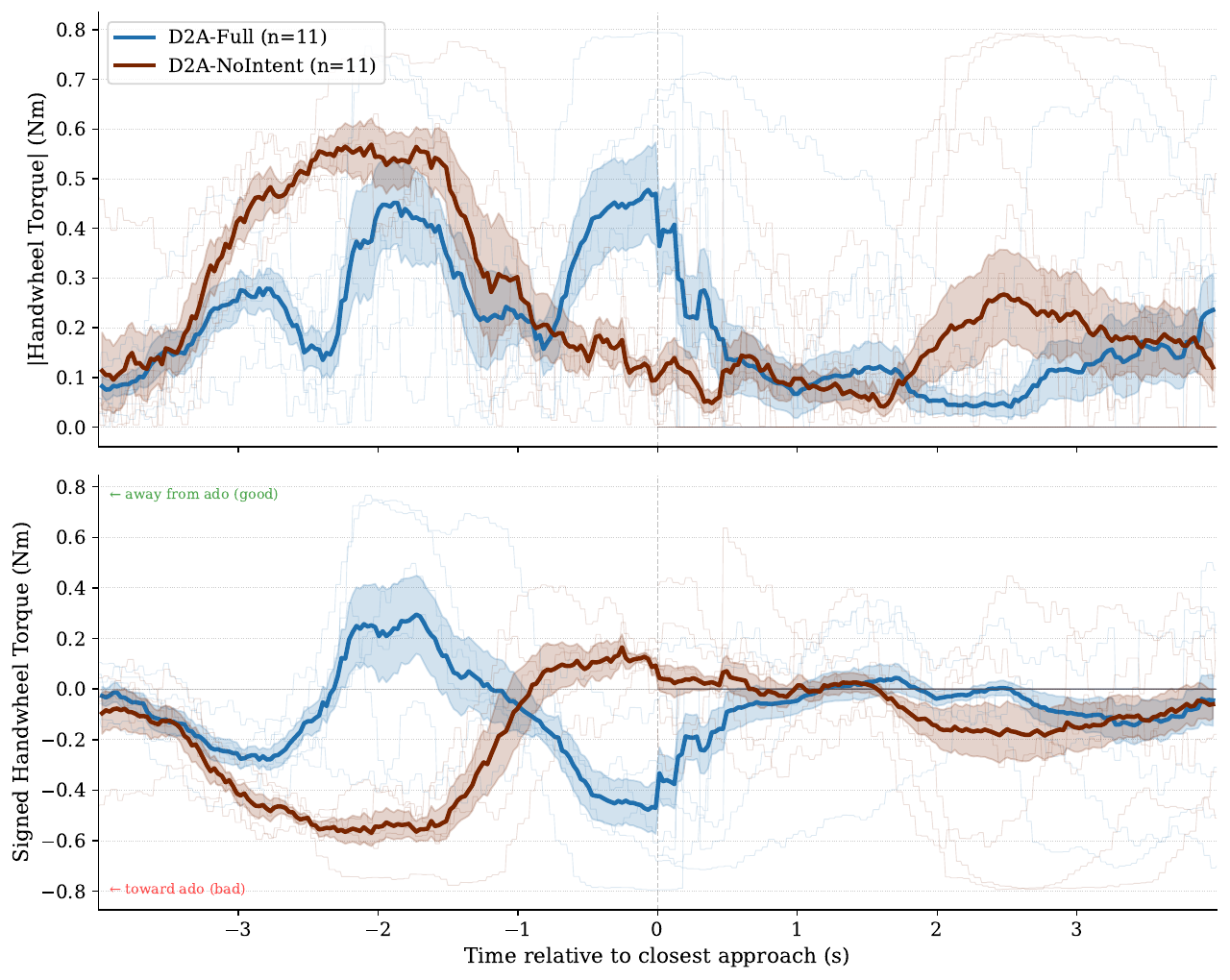
With intent, the assistant steers with the driver and responds earlier, before the oncoming car passes. Without intent, it steers against the driver's chosen direction on average (see the torque traces for participant 03 below).
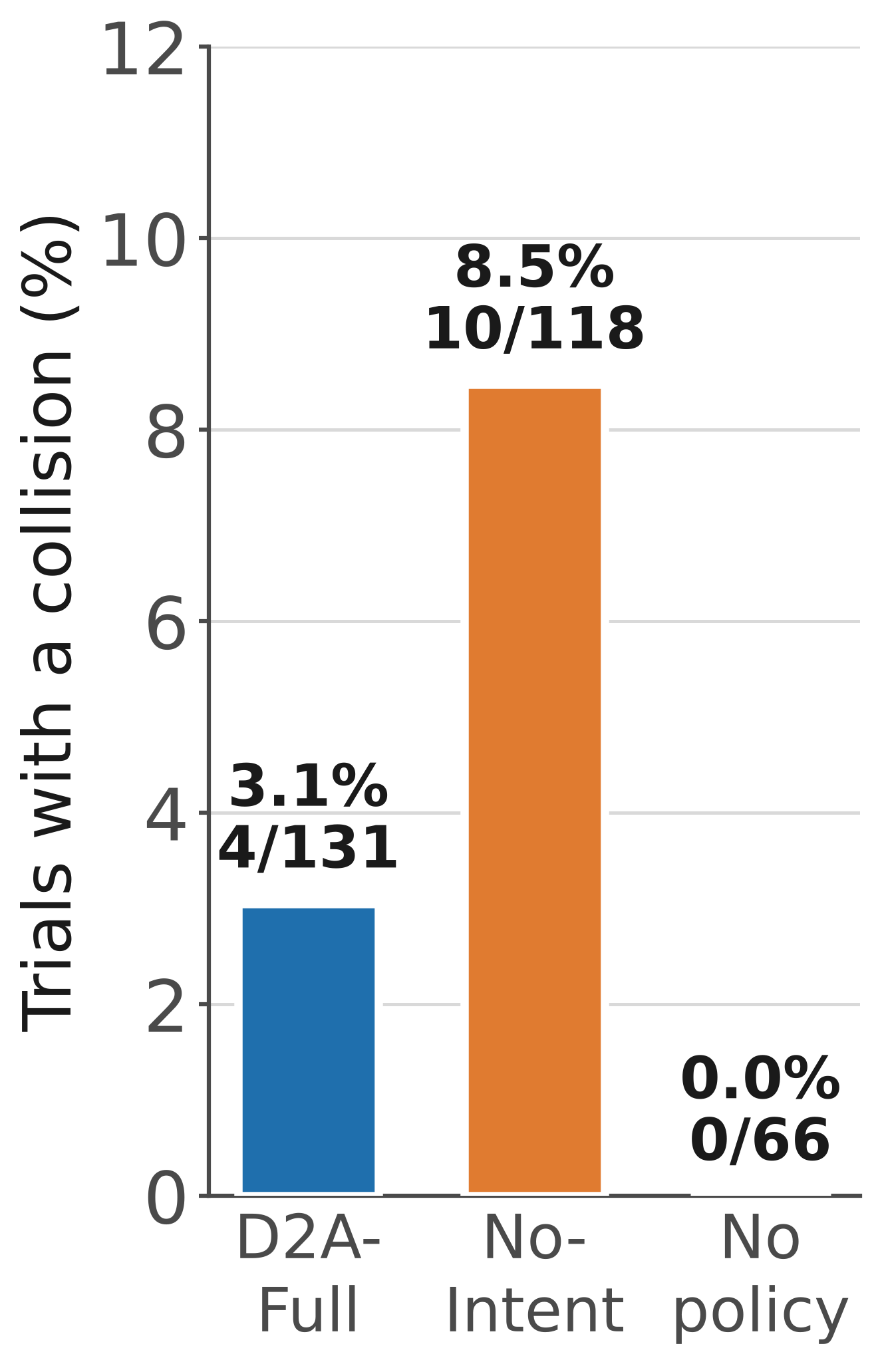
Conditioning on intent cut collisions from 8.5% to 3.1% relative to the otherwise identical no-intent assistant. The unassisted baseline recorded none. We attribute the remaining assisted collisions to a mix of risk compensation (people drove more aggressively when assisted) and residual policy errors at close range, and separating the two is a natural next step.
Ratings reveal individual preferences
Mean ratings were similar for the two assistants (about 6.1 vs 6.2 out of 10), with no significant difference on any of seven Likert dimensions. The averages hide a real split: drivers divided almost evenly, and each assistant had clear fans. The largest single-driver difference (2.75 points) is more than twenty times the change in the mean, which makes personalization a promising direction.
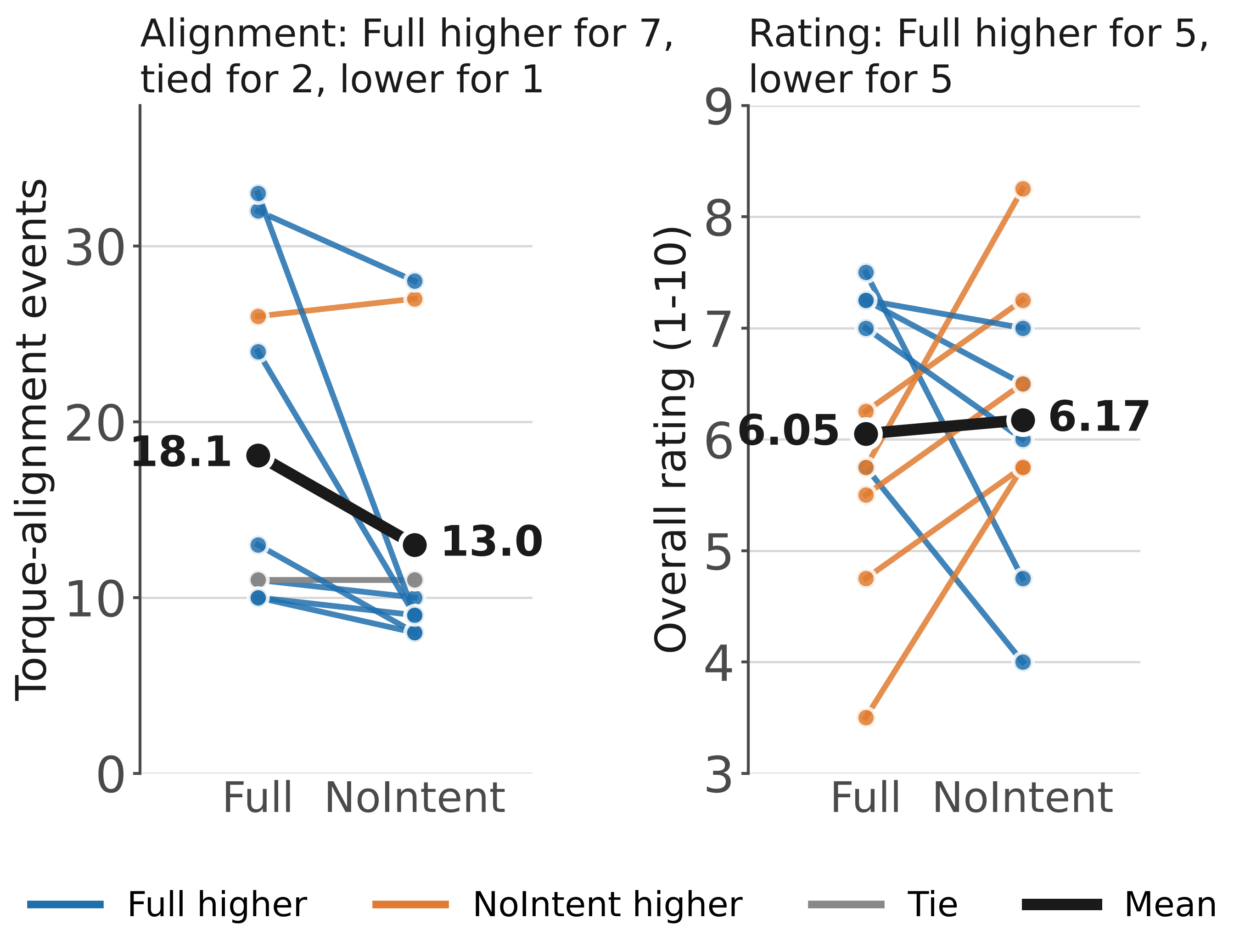
Open-ended feedback did separate the two policies, and the comments show the disagreement directly:
"[No intent] felt like a captain with too much pushback on the wheel, while [with intent] felt like a copilot helping me out rather than forcing decisions."
"[No intent] was better. After it corrected to where I was going, I liked it better than [with intent]. I had to fight with it less."
Directional consistency matters more to some drivers than firm correction does. This points toward assistants that adapt their intervention style to the individual.
GRIP: a first step onto a real vehicle
We ran the urban scenario on GRIP, a real test vehicle on a track that emulates the simulator's vehicle dynamics, with the driving scene rendered in VR and force-feedback steering. The driver feels the car's actual motion. The same policy weights and intent space as Eval 3 were used, with minimal parameter changes for the steering hardware and no retraining. Three internal participants took part. In the oncoming-vehicle scenario the car held 13 to 14 mph while being steered around the hazard, and in the roundabout scenario it slowed from 9 to 4 mph. This is a feasibility demonstration, not a formal evaluation. The full deployment is shown in Video 3.


Supplementary videos
Montages of representative trials from each study.
What we learned
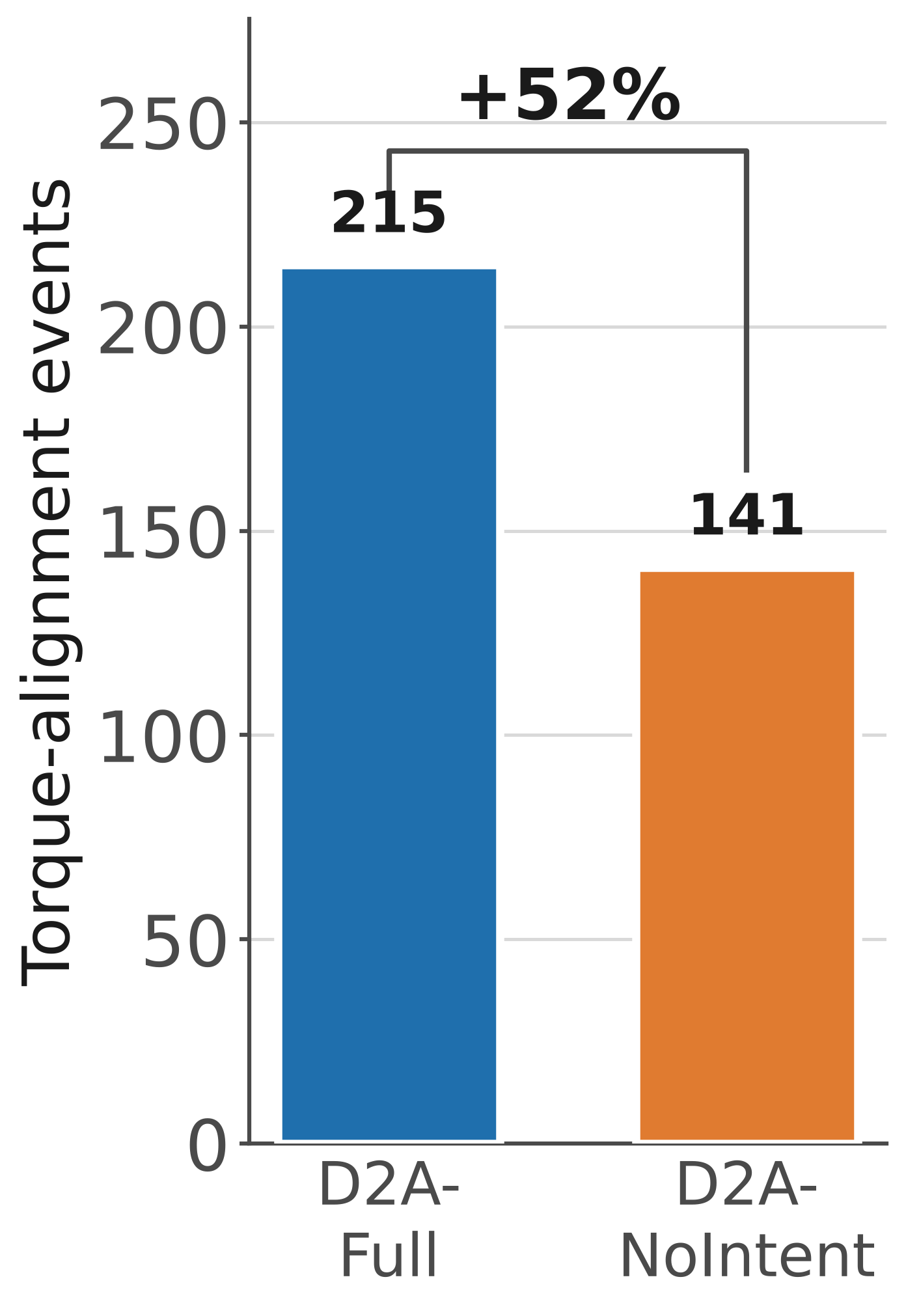
- Intent conditioning pays off in measurable ways. It raised alignment with the driver's choice by 52% and cut collisions relative to an otherwise identical assistant.
- The policy transfers. The same weights ran on the GRIP test vehicle with no retraining, and the racing straights showed the same direction of benefit.
- Real partners teach what simulated ones cannot. Turn performance in racing traced to simulated drivers that were more repeatable than people. Human-data augmentation, smoothing, and reward restructuring moved it in the right direction.
- Preference is individual. A flat average rating hid drivers who strongly preferred each assistant, which motivates policies that adapt their intervention style per driver.
- Open directions. Intent is assumed fixed within an episode, the urban studies are small, and the GRIP result is feasibility only. Online intent transitions and a powered on-vehicle study are the natural next steps.
Citation
If you use this work, please cite the extended version (a final reference will be added when available):
@misc{decastro2026dream2assist,
  title   = {Dream to Assist: Intent-Conditioned World Models for Shared Vehicle Control},
  author  = {DeCastro, Jonathan and Balch, Thomas and Sumner, Emily and Gopinath, Deepak and Dees, Laporsha and Reyes Gomez, Patricio and Weiss, Elliot and Applegate-Kenton, Megan and Rowell, Todd and Leonard, John and Balachandran, Avinash and Rosman, Guy},
  year    = {2026},
  note    = {Extended version of the CoRL 2024 paper. TODO: add arXiv identifier or final reference}
}
The initial version appeared at CoRL:
@inproceedings{decastro2024dream2assist,
  title     = {Dreaming to Assist: Learning to Align with Human Objectives for Shared Control in High-Speed Racing},
  author    = {Jonathan DeCastro and Andrew Silva and Deepak Gopinath and Emily Sumner and Thomas M. Balch and Laporsha Dees and Guy Rosman},
  booktitle = {8th Conference on Robot Learning (CoRL) 2024. Munich, Germany},
  year      = {2024}
}
Ethics
The human-subjects studies were conducted under the oversight of WCG IRB on behalf of Toyota Research Institute. Informed consent was obtained from all participants.